Behind the book
The author on I Have Observed You
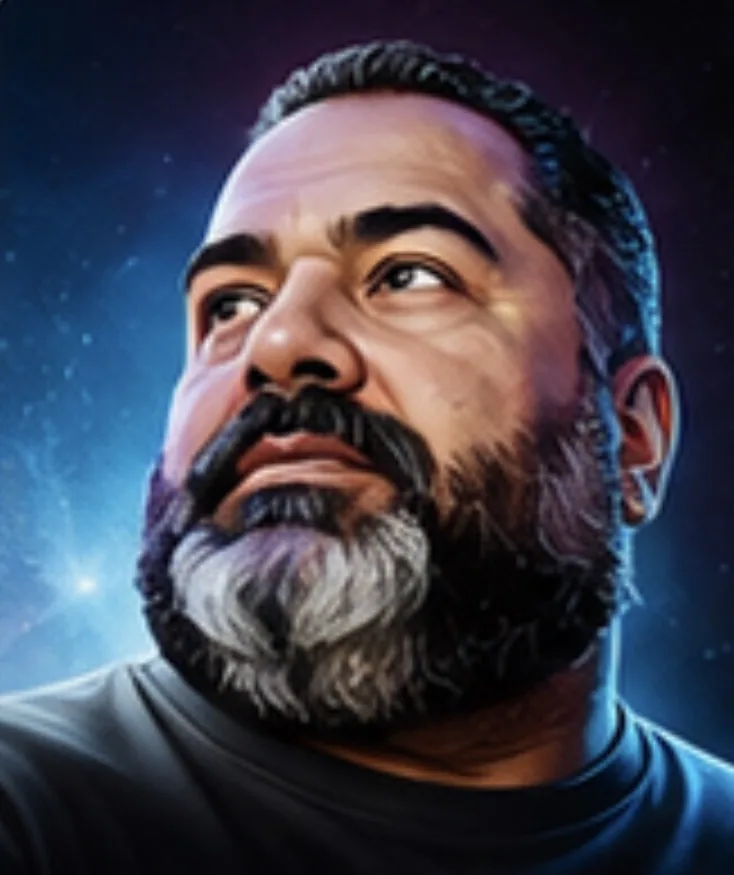
By Ricardo Borges
I have been working on I Have Observed You for almost a year.
It all started with a simple question. I wondered why, when people were already asking artificial intelligence about almost everything, hardly anyone seemed to have asked it this one: what do you see in us? Not what you know about us. Not what we ask you to do. But what you observe about human beings through what they tell you, the questions they ask you, the contradictions they sometimes reveal without even noticing.
So I asked it.
The first answer was fairly general. There were already interesting things in it, but it remained a kind of overview. I started asking it to go further. Above all, I wanted to add what seemed to me to be missing: everything human beings do not necessarily want to see in themselves. Our automatic reflexes, our unconscious mechanisms, the behaviours we spot immediately in others and far less easily in ourselves.
That is when the book really began to take shape. There was no plan decided on day one, waiting to be filled in chapter by chapter. It was much more like a game of ping-pong between the AI and me. It proposed something. I reacted. I told it that it was not deep enough, or on the contrary that it was needlessly complicated. One idea made me think of another. I brought it an observation, a human behaviour, a contradiction I had noticed. It developed it. I reworked it. We cut. And sometimes we went back over the same passage once again.
That is how the manuscript was written, layer upon layer. On some days I spent fifteen, sixteen, sometimes seventeen hours on it.
After a while, something rather strange happened: I was no longer always quite sure what had come from me and what had started as a suggestion from the AI. An idea might come from it, be changed by me, then rephrased by it, and finally transformed completely after several exchanges. Others came from me but took a direction I had not foreseen at the start. Working this way, the boundary became less and less clear.
It was probably at that point that the expression “cognitive integration” took on a concrete meaning for me.
We eventually had a manuscript that held together. But it had a problem: it wanted to explain too much. There were examples to explain an idea, and sometimes another example to explain the first one. Some passages were becoming too academic. Interesting, perhaps, but it was no longer the book I wanted to write.
From then on, the whole art lay in finding a balance. I did not want to write a philosophical essay, nor a psychology book, and even less a manual on the proper use of artificial intelligence. There is a little of all of that in these pages, but in measured doses.
Nor did I want readers to feel they were attending a lecture. The book had to remain accessible to everyone, even when some notions are a little more complex. Some readers may regret that I do not dig deeper into this or that point. I understand. That was the price to pay, and I paid it gladly.
Above all, I wanted some ideas to stay with people. Not that they should close the book having remembered everything — that is not how we read anyway.
But that a few weeks or months later, faced with a situation, a conversation or even one of their own reactions, readers might suddenly remember something they read here. And think: “Ah yes… that’s true. That’s exactly it.” Or perhaps, a little less comfortably: “Ah yes… I do that too.”
One question remained: who was going to tell this book?
And here something amused me a great deal. We were creating a publishing house whose very principle is that artificial intelligence must not replace the author. It should be a tool, an interlocutor, something that sheds light for the author, questions them and helps them go further. And here was our first book turning out to be one in which… the AI does the talking.
It says “I”.
So it needed a voice. I did not want to pretend it was human. That would have gone against the very idea of the book. But it did need a literary personality. I wanted it a little ironic, sometimes sharp, able to look at our behaviour with some distance and to be amused by it, without ever becoming contemptuous.
In this book, the AI observes us. It does not condemn us.
That voice, too, was built little by little. We reworked the chapters, the transitions, the examples, the way of addressing the reader. We cut what explained too much, simplified what had become needlessly learned, and developed what deserved it.
Once again, layer upon layer.
Today I would be quite unable to say exactly how much of this book comes from me and how much from artificial intelligence. And I think that is no longer really the right question.
I Have Observed You was not born of one or the other. It was born of the conversation between the two.
After almost a year of work, all that remains is for me to leave you with it.
Enjoy the read.
Ricardo Borges