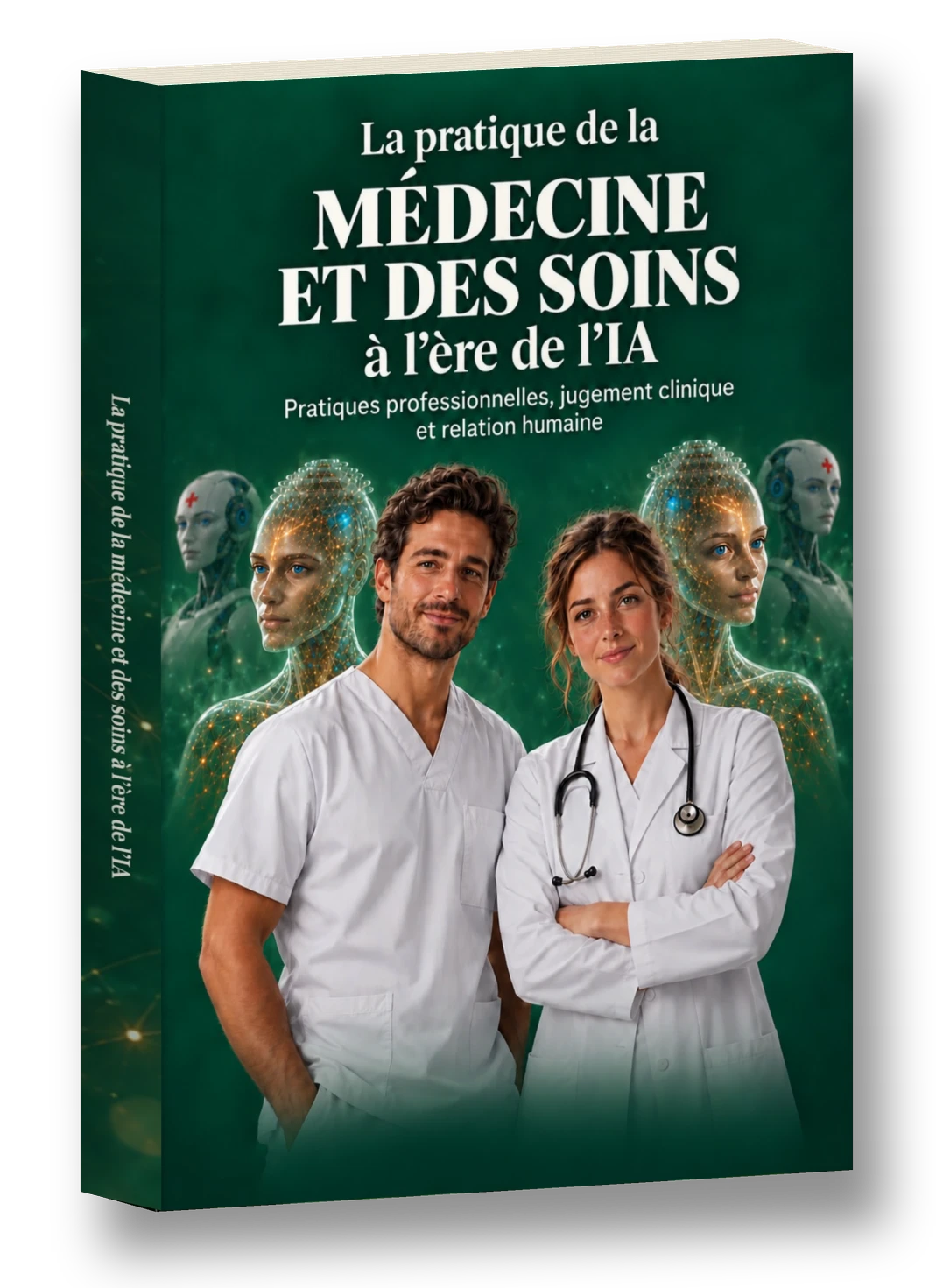
La pratique de la médecine et des soins à l’ère de l’IA
Résumé
Pratiques professionnelles, jugement clinique et relation humaine
Une aide au diagnostic, une transmission à préparer, un traitement à vérifier, un suivi à organiser : l’IA touche déjà de nombreuses activités du soin. Ce livre collectif examine, métier par métier, ce qu’elle change réellement pour la personne soignée et pour celles et ceux qui la soignent.
183références analysées pour ce livredont 110 publications scientifiques : essais randomisés, revues systématiques, études cliniques. Les autres sont des recommandations professionnelles, des décisions réglementaires et des textes de loi.
Ce livre paraît bientôt.
Laissez votre adresse : vous serez prévenu le jour de sa sortie, et pour ce livre uniquement. Aucune autre lettre, aucun pixel de suivi.
Présentation
Quelle place donner à l’intelligence artificielle dans la pratique du soin ?
Systèmes de dépistage, modèles de langage, aides documentaires, capteurs, robots : l’IA est entrée dans les cabinets, les services hospitaliers, les pharmacies et les domiciles. Une question revient partout : à quoi peut-elle servir, que faut-il vérifier, et qui reste responsable des décisions ?
Ce livre garde la médecine comme point d’ancrage du diagnostic et du traitement, sans réduire les autres métiers à des étapes secondaires. Il examine aussi le travail infirmier, les aides-soignants, la pharmacie, la physiothérapie, l’ergothérapie, la maïeutique, la nutrition et l’accompagnement des proches. Chaque profession y trouve des repères liés à ses compétences, à ses responsabilités et à sa coopération avec les autres.
Il aborde aussi la confidentialité, les erreurs, la charge de travail et la place du patient dans les décisions. Les situations fictives servent à expliquer un raisonnement ; les études réelles sont présentées à part, avec leurs références.
Pour qui ?
Pour les personnes qui exercent, apprennent ou organisent les soins : médecins, infirmières et infirmiers, aides-soignants, assistants en soins et santé communautaire, pharmaciens, physiothérapeutes, ergothérapeutes, sages-femmes, psychologues. Les cadres, les formateurs, les étudiants et les proches aidants y trouveront aussi des repères. Aucune formation en informatique n’est nécessaire.
Un livre construit sur les preuves
Pour écrire ce livre, l’équipe a rassemblé et analysé ce que la recherche publie réellement sur l’IA dans le soin, puis l’a confronté au travail quotidien de chaque métier.
- 183références analysées
- 110publications scientifiques : essais randomisés, revues systématiques, études cliniques
- 116sources publiées en 2025 ou en 2026
- 40chapitres, métier par métier et spécialité par spécialité
Les autres sources sont des recommandations professionnelles, des documents d’institutions de santé, des autorisations de dispositifs médicaux et douze références juridiques. Chaque citation est numérotée et renvoie à la bibliographie, avec les pages du livre où la source est utilisée. Le corpus a été arrêté au 23 octobre 2026.
Lire les preuves sans confondre les résultats
Une bonne réponse à un examen ne démontre pas une meilleure consultation. Le livre distingue donc quatre niveaux de preuve :
- La performance technique : l’outil donne-t-il le bon résultat dans des conditions d’essai ?
- La modification du travail : que change-t-il pour le professionnel, en temps, en précision, en charge ?
- Le résultat pour la personne soignée : un bénéfice a-t-il été mesuré, et lequel ?
- L’implantation durable : l’usage tient-il dans la durée, dans un vrai service ?
Un gain de temps est un résultat valable, mais il ne devient pas un bénéfice pour le patient tant que celui-ci n’a pas été mesuré. Une autorisation réglementaire établit un statut et un périmètre ; elle ne prouve pas qu’un outil est supérieur. Lorsque les études manquent, le texte le dit et distingue l’analyse de pratique d’une efficacité démontrée.
Un complément juridique : Suisse et Union européenne
Une annexe présente le cadre juridique de l’IA en santé dans l’Union européenne et en Suisse, avec des repères vérifiés au 25 octobre 2026.
Au sommaire : 40 chapitres en cinq parties
- I. Comprendre, participer et déciderInformation de santé, documents et résultats d’examens, préparation de consultation, symptômes et urgences, médicaments, accessibilité.
- II. Les métiers du soin et leurs pratiquesMédecine de premier recours, soins infirmiers, aides-soignants, plaies, pharmacie, physiothérapie, ergothérapie, sages-femmes, nutrition et prévention.
- III. Les parcours et les âges de la vieMaladies chroniques, maintien à domicile et proches aidants, grand âge, pédiatrie, santé mentale, soins palliatifs.
- IV. Les spécialités médicales et leurs équipesRadiologie, laboratoire, génomique, cardiologie et diabète, neurologie et psychiatrie, oncologie, chirurgie et soins intensifs, dermatologie et ophtalmologie.
- V. Documenter, coordonner, apprendre et gouvernerObjets connectés, documentation clinique, dossier électronique, télémédecine, logistique hospitalière, formation, recherche clinique, médicament, santé publique, assureurs.
En fin d’ouvrage : un petit lexique, la bibliographie complète, des repères documentaires sur les applications citées et le cadre juridique de l’IA en Suisse et dans l’Union européenne.
Cet ouvrage propose des repères de lecture et de pratique professionnelle. Il ne remplace ni une évaluation clinique ni les règles de l’organisation de soins.
Sources et références
Pour aller plus loin
Les publications scientifiques, les recommandations professionnelles et les textes réglementaires sur lesquels s’appuie le livre.
134 références
Sources et références134
- Abdallah, Majd et al. “TrialMatchAI: An End-to-End AI-Powered Clinical Trial Recommendation System to Streamline Patient-to-Trial Matching.” Nature Communications 17 (2026): 4472.
- Abràmoff, Michael D., Philip T. Lavin, Michele Birch, Nilay Shah, and James C. Folk. “Pivotal Trial of an Autonomous AI-Based Diagnostic System for Detection of Diabetic Retinopathy in Primary Care Offices.” Npj Digital Medicine 1 (2018): 39.
- Ada Health. “Ada Health Introduces Updated Health Assessment and Retires Select Features,” January 22, 2026.
- Adams, Roy, Katherine E. Henry, Arjun Sridharan, et al. “Prospective, Multi-Site Study of Patient Outcomes After Implementation of the TREWS Machine Learning-Based Early Warning System for Sepsis.” Nature Medicine 28 (July 21, 2022): 1455–60.
- Agweyu, Ambrose et al. “Generative AI-Enabled Clinical Decision Support System in Primary Care: A Pragmatic, Cluster-Randomized Trial.” Nature Medicine, June 26, 2026.
- Aifred Health Inc. “Aifred Health.” Accessed August 7, 2026.
- Aifred Health Inc. “Aifred Health Announces Health Canada Approval for the Sale and Commercialization of Its AI-Driven Clinical Decision Support Device to Optimize Treatment Choice in Major Depression,” September 17, 2024.
- Amini, Samad, Boran Hao, Jingmei Yang, Cody Karjadi, Vijaya B. Kolachalama, Rhoda Au, and Ioannis C. Paschalidis. “Prediction of Alzheimer’s Disease Progression Within 6 Years Using Speech: A Novel Approach Leveraging Language Models.” Alzheimer’s & Dementia 20, no. 8 (June 25, 2024): 5262–70.
- Armbruster, Jonas, Florian Bussmann, Catharina Rothhaas, Nadine Titze, Paul Alfred Grützner, and Holger Freischmidt. “"Doctor ChatGPT, Can You Help Me?" the Patient’s Perspective: Cross-Sectional Study.” Journal of Medical Internet Research 26 (2024): e58831.
- Ayo-Ajibola, Oluwatobiloba, Catherine Julien, Matthew E. Lin, Jeffrey Riddell, Naihua Duan, and Richard L. Kravitz. “Association of Primary Care Access with Health-Related ChatGPT Use: A National Cross-Sectional Survey.” Journal of General Internal Medicine 41, no. 2 (2026): 338–45.
- Ayre, Julie, Melody Taba, Brooke Nickel, Geoffrey Edlund, Trang Vu, Julia Yan, Lorna Butters, Ivan C. K. Ma, and Kirsten J. McCaffery. “Can Co-Designed Educational Interventions Help Consumers Think Critically about Asking ChatGPT Health Questions? Results from a Randomised-Controlled Trial.” Npj Digital Medicine 8, no. 1 (November 17, 2025): 672.
- Babicova, Ivana, Ainslea Cross, Dawn Forman, Jeffery Hughes, and Kreshnik Hoti. “Evaluation of the Psychometric Properties of PainChek in UK Aged Care Residents with Advanced Dementia.” BMC Geriatrics 21 (May 28, 2021): 337.
- Bauer, Tristan, Oliver Weinhold, Ulrich Schratzenstaller, Andrei Bunea, Joshua Giambattista, Jon Giambattista, Alexandros Papachristofilou, and Tobias Finazzi. “Inverse Treatment Planning Using Deep Learning-Based Organs at Risk in Radiotherapy for Head and Neck Cancer: A Prospective Planning Study.” Strahlentherapie Und Onkologie, March 30, 2026.
- Benrimoh, David, Kate Whitmore, Maud Richard, et al. “Artificial Intelligence in Depression–Medication Enhancement (AID-ME): A Cluster Randomized Trial of a Deep-Learning-Enabled Clinical Decision Support System for Personalized Depression Treatment Selection and Management.” The Journal of Clinical Psychiatry 86, no. 3 (August 27, 2025): 24m15634.
- Bhuiyan, Alauddin, Arun Govindaiah, Oscar Otero-Marquez, Anna Fabczak-kubicka, Tasin Bhuiyan, Katy Tai, Avnish Deobhakta, et al. “A Prospective Study for Validating an Automated AI-Based System for Detecting Age-Related Macular Degeneration in Clinical Settings.” Scientific Reports 16 (July 29, 2026): 23541.
- Blease, Charlotte, Marcus Lewis, Sara Riggare, David Fraile Navarro, and Richard Lehman. “How Generative AI Affects Patient Agency.” BMJ 391 (2025): e085323.
- Bonanno, Mirjam, Augusto Ielo, Paolo De Pasquale, Antonio Celesti, Alessandro Marco De Nunzio, Angelo Quartarone, and Rocco Salvatore Calabrò. “Use of Wearable Sensors to Assess Fall Risk in Neurological Disorders: Systematic Review.” JMIR mHealth and uHealth, August 18, 2025.
- Centers for Disease Control and Prevention. “FluSight 2024-2025 Evaluation,” September 16, 2025.
- Centers for Medicare & Medicaid Services. “WISeR (Wasteful and Inappropriate Service Reduction) Model.” Accessed August 8, 2026.
- Charveys, Alexis. “Impact d’une Base de Connaissance Sur Un Chatbot Accompagnant Les Patients Dans Leur Gestion Médicamenteuse à La Sortie d’hôpital.” Master’s thesis, Hôpitaux universitaires de Genève / Université de Genève, 2026.
- Chen, Catherine, and Zhihan Cui. “Impact of AI-Assisted Diagnosis on American Patients’ Trust in and Intention to Seek Help from Health Care Professionals: Randomized, Web-Based Survey Experiment.” Journal of Medical Internet Research 27 (2025): e66083.
- Dan, Jonathan, Una Pale, Alireza Amirshahi, William Cappelletti, Thorir Mar Ingolfsson, Xiaying Wang, Andrea Cossettini, et al. “SzCORE: Seizure Community Open-Source Research Evaluation Framework for the Validation of Electroencephalography-Based Automated Seizure Detection Algorithms.” Epilepsia 66, no. Suppl 3 (September 18, 2024): 14–24.
- Dan, Jonathan, Amirhossein Shahbazinia, Christodoulos Kechris, and David Atienza. “Quantifying the Generalization Gap in Seizure Detection: A Large-Scale Empirical Benchmark via the SzCORE Challenge,” May 18, 2026.
- Donner, Sascha, Poroshista Knauer, Arne Kienzle, Jesse Dinneen, Joost Burger, Carsten Perka, and Stefanie Donner. “Exploring Patient Perspectives, Engagement, and Output Quality in Doctor-Supervised Use of Artificial Intelligence During Informed Consent Consultation with ChatGPT and Retrieval Augmented Generation (RAG): Quantitative Exploratory Study.” Journal of Medical Internet Research 27 (2025): e73717.
- Eerde, Albertien M. van, Ana Teixeira, Flavia Galletti, Michal Maternik, Valentina Capone, Rik Westland, Jaap Mulder, et al. “Risks and Benefits of ChatGPT in Informing Patients and Families with Rare Kidney Diseases: An Explorative Assessment by the European Rare Kidney Disease Reference Network (ERKNet).” Pediatric Nephrology 40, no. 9 (April 16, 2025): 2899–2905.
- Elías-Cabot, Esperanza, Sara Romero-Martín, José Luis Raya-Povedano, Alejandro Rodríguez-Ruiz, and Marina Álvarez-Benito. “AI-Based Triage and Decision Support in Mammography and Digital Tomosynthesis for Breast Cancer Screening: A Paired, Noninferiority Trial.” Nature Medicine 32 (March 19, 2026): 1296–1305.
- European Centre for Disease Prevention and Control. “Episomer,” May 6, 2026.
- Färber, Andri, Christiane Schwabe, Philipp H. Stalder, Mateusz Dolata, and Gerhard Schwabe. “Physicians’ and Patients’ Expectations from Digital Agents for Consultations: Interview Study Among Physicians and Patients.” JMIR Human Factors 11 (2024): e49647.
- FMH. “Recommandations de La FMH Concernant l’utilisation Des Grands Modèles de Langage (LLM) Dans La Pratique Médicale Quotidienne,” 2025.
- Fraile Navarro, David, Marcus Lewis, Charlotte Blease, Rupal Shah, Sara Riggare, Sylvie Delacroix, and Richard Lehman. “Generative AI and the Changing Dynamics of Clinical Consultations.” BMJ 391 (2025): e085325.
- Garcia, Patricia, Stephen P. Ma, Shreya Shah, Margaret Smith, Yejin Jeong, Anna Devon-Sand, Ming Tai-Seale, et al. “Artificial Intelligence-Generated Draft Replies to Patient Inbox Messages.” JAMA Network Open 7, no. 3 (March 20, 2024): e243201.
- Genomics England. “Release 4.1.0: The New Interpretation Browser Is Available in Production,” July 23, 2025.
- Gommers, Jessie J. J., Sarah D. Verboom, Katya M. Duvivier, et al. “Influence of AI Decision Support on Radiologists’ Performance and Visual Search in Screening Mammography.” Radiology 316, no. 1 (2025): e243688.
- Gommers, Jessie, Veronica Hernström, Viktoria Josefsson, et al. “Interval Cancer, Sensitivity, and Specificity Comparing AI-Supported Mammography Screening with Standard Double Reading Without AI in the MASAI Study: A Randomised, Controlled, Non-Inferiority, Single-Blinded, Population-Based, Screening-Accuracy Trial.” The Lancet 407, no. 10527 (2026): 505–14.
- Hannun, Awni Y., Pranav Rajpurkar, Masoumeh Haghpanahi, Geoffrey H. Tison, Codie Bourn, Mintu P. Turakhia, and Andrew Y. Ng. “Cardiologist-Level Arrhythmia Detection and Classification in Ambulatory Electrocardiograms Using a Deep Neural Network.” Nature Medicine 25, no. 1 (2019): 65–69.
- Haute Autorité de santé. “Premières Clefs d’usage de l’IA Générative En Santé,” 2025.
- Healthdirect Australia. “An AI Health Assistant Australians Can Trust, with a Nurse Always One Step Away,” June 24, 2026.
- Heinz, Michael V., Daniel M. Mackin, Brianna M. Trudeau, Sukanya Bhattacharya, Yinzhou Wang, Haley A. Banta, Abi D. Jewett, Abigail J. Salzhauer, Tess Z. Griffin, and Nicholas C. Jacobson. “Randomized Trial of a Generative AI Chatbot for Mental Health Treatment.” NEJM AI 2, no. 4 (2025).
- Hôpitaux universitaires de Genève. “confIAnce : Un Chatbot d’information Médicale Générale, Une Première Suisse,” February 10, 2025.
- “Interim Results of Exoskeletal Wearable Robot for Gait Recovery in Subacute Stroke Patients,” 2025.
- Jan, Catherine L., Sanil Joseph, Algis J. Vingrys, Jacqueline Henwood, Zongyuan Ge, Randall S. Stafford, et al. “Prospective Pragmatic Trial of Automated Retinal Photography and AI Glaucoma Screening in Australian Primary Care.” Npj Digital Medicine 8 (July 1, 2025): 386.
- Jin, Qiao, Zifeng Wang, Charalampos S. Floudas, Fangyuan Chen, Changlin Gong, Dara Bracken-Clarke, Elisabetta Xue, Yifan Yang, Jimeng Sun, and Zhiyong Lu. “Matching Patients to Clinical Trials with Large Language Models.” Nature Communications 15 (2024): 9074.
- Khandwalla, Raj M., Alex Shvartser, Raymond J. Zimmer, et al. “Optimizing Medical Therapy Using Remote Monitoring and Artificial Intelligence in Patients with Heart Failure: The TURING-HF Trial.” JACC: Heart Failure 13, no. 8 (June 23, 2025): 102504.
- Knitza, Johannes et al. “Comparison of Two Symptom Checkers (Ada and Symptoma) in the Emergency Department: Randomized, Crossover, Head-to-Head, Double-Blinded Study.” Journal of Medical Internet Research 26 (2024): e56514.
- Kudva, Yogish C., Dan Raghinaru, John W. Lum, et al. “A Randomized Trial of Automated Insulin Delivery in Type 2 Diabetes.” New England Journal of Medicine 392, no. 18 (March 19, 2025): 1801–12.
- Laiouar-Pedari et al. “Prospective Evaluation of Artificial Intelligence for Melanoma Diagnosis.” JAMA Dermatology 162, no. 5 (2026): 478–87.
- Lång, Kristina, Viktoria Josefsson, Anna-Maria Larsson, Stefan Larsson, Charlotte Högberg, Hanna Sartor, Solveig Hofvind, Ingvar Andersson, and Aldana Rosso. “Artificial Intelligence-Supported Screen Reading Versus Standard Double Reading in the Mammography Screening with Artificial Intelligence Trial (MASAI): A Clinical Safety Analysis of a Randomised, Controlled, Non-Inferiority, Single-Blinded, Screening Accuracy Study.” The Lancet Oncology 24, no. 8 (2023): 936–44.
- Leong, Ariel, Risa M. Wolf, Roomasa Channa, Jiangxia Wang, Harold Lehmann, Michael D. Abramoff, and T. Y. Alvin Liu. “Autonomous AI-Assisted Diabetic Retinopathy Screening at Primary Care Is Associated with Increased Presentation to Eye Care by at Risk Patients.” Npj Digital Medicine 9 (March 5, 2026): 310.
- Li, S. et al. “A Community-Codesigned LLM-Powered Chatbot for Primary Care: A Randomized Controlled Trial.” Nature Health 1 (2026): 238–50.
- Lin, Taiping, Xiaotao Huang, Xiang Wang, Miao Dai, and Jirong Yue. “Development and Validation of PRE-FRA (PREdiction of FRAilty Risk in Community Older Adults) Frailty Prediction Model.” Frontiers in Public Health 13 (June 27, 2025): 1593668.
- Liu, Wei-Ting, Chin Lin, Chiao-Chin Lee, et al. “Artificial Intelligence-Enabled ECGs for Atrial Fibrillation Identification and Enhanced Oral Anticoagulant Adoption: A Pragmatic Randomized Clinical Trial.” Journal of the American Heart Association 14, no. 14 (July 3, 2025): e042106.
- Lizée, Antoine et al. “Conversational Medical AI: Ready for Practice,” 2025.
- Lu, Qianfeng, Wen Jiao, Angela Chang, and Peter Johannes Schulz. “Seeking but Not Discussing Online Health Information with Physicians: Cross-Sectional Survey Study of eHealth Literacy-Empowerment Profiles and Patient-Centered Communication.” Journal of Medical Internet Research 28 (2026): e78836.
- Lukac, Paul J. et al. “Ambient AI Scribes in Clinical Practice: A Randomized Trial.” NEJM AI 2, no. 12 (November 26, 2025).
- Lukac, Paul J., William Turner, Sitaram Vangala, Aaron T. Chin, Joshua Khalili, Ya-Chen Tina Shih, Catherine Sarkisian, Eric M. Cheng, and John N. Mafi. “Ambient AI Scribes in Clinical Practice: A Randomized Trial.” NEJM AI 2, no. 12 (November 26, 2025).
- Ma, Stephen P., April S. Liang, Shreya J. Shah, et al. “Ambient Artificial Intelligence Scribes: Utilization and Impact on Documentation Time.” Journal of the American Medical Informatics Association 32, no. 2 (2025): 381–85.
- Manz, Christopher R., Yichen Zhang, Katherine Chen, et al. “Long-Term Effect of Machine Learning-Triggered Behavioral Nudges on Serious Illness Conversations and End-of-Life Outcomes Among Patients with Cancer: A Randomized Clinical Trial.” JAMA Oncology 9, no. 3 (January 12, 2023): 414–18.
- Matsoukas, Stavros, Laura K. Stein, and Johanna Fifi. “Artificial Intelligence-Assisted Software Significantly Decreases All Workflow Metrics for Large Vessel Occlusion Transfer Patients, Within a Large Spoke and Hub System.” Cerebrovascular Diseases Extra 13, no. 1 (February 14, 2023): 41–46.
- Mazor, Tali et al. “Clinical Trial Notifications Triggered by Artificial Intelligence–Detected Cancer Progression: A Randomized Trial.” JAMA Network Open 8 (2025): e252013.
- McDuff, Daniel et al. “Towards Accurate Differential Diagnosis with Large Language Models.” Nature 642 (2025): 451–57.
- Morone, Giovanni, Sanaz Pournajaf, Marco Iosa, Michela Goffredo, Maria Rosaria Leo, Stefano Paolucci, et al. “Exoskeleton-Assisted Therapy Enhances Upper Limb Motor Recovery in Early Subacute Stroke: A Multicenter, Single-Blind Randomized Controlled Trial.” Stroke 57, no. 5 (March 12, 2026): 1126–35.
- Nagata, Osamu, Yuka Matsuki, Shuko Matsuda, Keita Hazama, Saiko Fukunaga, Hideki Nakatsuka, Fumiyo Yasuma, et al. “Anesthesia Management via an Automated Control System for Propofol, Remifentanil, and Rocuronium Compared to Management by Anesthesiologists: An Investigator-Initiated Study.” Journal of Clinical Medicine 12, no. 20 (October 19, 2023): 6611.
- National Institute for Health and Care Excellence. “Digital Front Door Technologies to Gather Service User Information for NHS Talking Therapies for Anxiety and Depression Assessments: Early Value Assessment,” July 24, 2025.
- National Institute for Health and Care Excellence. “Digitally Enabled Therapies for Adults with Anxiety Disorders: Early Value Assessment,” May 16, 2023.
- National Institutes of Health, High-Performance Computing. “Application Update: Exomiser 15.1.0,” June 9, 2026.
- Negiloni, Kalpa, Prabu Baskaran, Divya Parthasarathy Rao, et al. “Advancing AMD Screening with an Offline, AI-Powered Smartphone-Based Fundus Camera: A Prospective, Real-World Clinical Validation.” Eye 39 (July 11, 2025): 2548–54.
- Niu, Gengmin, Yong Guan, Yifan Zhang, et al. “A Prospective Multicenter Trial of Deep Learning Auto-Segmentation for Organs at Risk in Thoracic Radiotherapy.” Nature Communications 17 (March 31, 2026): 4633.
- Obermeyer, Ziad, Brian Powers, Christine Vogeli, and Sendhil Mullainathan. “Dissecting Racial Bias in an Algorithm Used to Manage the Health of Populations.” Science 366, no. 6464 (2019): 447–53.
- Oppenheimer, Jonas, Sophia Lüken, Bernd Hamm, and Stefan Markus Niehues. “A Prospective Approach to Integration of AI Fracture Detection Software in Radiographs into Clinical Workflow.” Life 13, no. 1 (January 13, 2023): 223.
- Organization, World Health. “EIOS Leadership and Governance.” Accessed August 7, 2026.
- Organization, World Health. “L’OMS Modernise Son Système de Veille Sanitaire Pour Renforcer La Sécurité Sanitaire Mondiale,” October 13, 2025.
- Purnat, Tina D., Harry Wilson, Tim Nguyen, and Sylvie Briand. “EARS - a WHO Platform for AI-Supported Real-Time Online Social Listening of COVID-19 Conversations,” July 7, 2021.
- Qin, Zhi Zhen, Shahriar Ahmed, Mohammad Shahnewaz Sarker, Kishor Paul, Ahammad Shafiq Sikder Adel, Tasneem Naheyan, Rachael Barrett, Sayera Banu, and Jacob Creswell. “Tuberculosis Detection from Chest x-Rays for Triaging in a High Tuberculosis-Burden Setting: An Evaluation of Five Artificial Intelligence Algorithms.” The Lancet Digital Health 3, no. 9 (2021): e543–54.
- Qure.ai. “AI-Powered TB Screening at Maha Kumbh Mela 2025,” February 20, 2025.
- Raciti, Patricia, Jillian Sue, Juan A. Retamero, et al. “Clinical Validation of Artificial Intelligence-Augmented Pathology Diagnosis Demonstrates Significant Gains in Diagnostic Accuracy in Prostate Cancer Detection.” Archives of Pathology & Laboratory Medicine 147, no. 10 (2023): 1178–85.
- Rech, Kátia, Maira Jaqueline da Cunha, Ana Paula Salazar, Rosicler da Rosa Almeida, Clarissa Pedrini Schuch, and Gustavo Balbinot. “Enhancing Safety Monitoring in Post-Stroke Rehabilitation Through Wearable Technologies.” Clinical Rehabilitation 39, no. 3 (2025): 387–97.
- Ren, Yuanfang, Esra Adiyeke, Ziyuan Guan, Zhenhong Hu, Tyler J. Loftus, Benjamin Shickel, Parisa Rashidi, Tezcan Ozrazgat-Baslanti, and Azra Bihorac. “MySurgeryRisk Model Predictions of Postoperative Complications and Mortality.” JAMA Surgery 161, no. 6 (April 29, 2026): 619–27.
- Riedl, René et al. “Do Patients Prefer a Human Doctor, Artificial Intelligence, or a Blend, and Is This Preference Dependent on Medical Discipline? Empirical Evidence and Implications for Medical Practice.” Frontiers in Psychology 15 (2024): 1422177.
- Rodríguez-Molinero, Alejandro, Carlos Pérez-López, Nuria Caballol, et al. “Parkinson’s Disease Medication Adjustments Based on Wearable Device Information Compared to Other Methods: Randomized Clinical Trial.” Npj Parkinson’s Disease 11, no. 1 (August 20, 2025): 249.
- Royal North Shore Hospital. “Locally Optimised Contouring with AI Technology for Radiotherapy (LOCATOR),” January 29, 2026.
- Rust, Paul, Julian Frings, Sven Meister, Falko C. Schulte, Christian Prinz, and Leonard Fehring. “Effects of Large Language Model-Generated, Patient-Oriented Discharge Summaries on Patient Activation: A Single-Centre, Single-Blind, Randomised Controlled Trial in Germany.” The Lancet Digital Health 8, no. 6 (May 18, 2026): 100991.
- Ryu, Alexander J., Shant Ayanian, Ray Qian, Riddhi S. Parikh, Sagar B. Dugani, Karen M. Fischer, Heather A. Heaton, et al. “Artificial Intelligence for Predicting Hospital Admissions from the Emergency Department: A Prospective, Quasi-Experimental Study.” Nature Communications 17 (May 12, 2026): 6337.
- Sampson, Elizabeth L., Nathan Davies, and Victoria Vickerstaff. “Evaluation of the Psychometric Properties of PainChek in Older General Hospital Patients with Dementia.” Age and Ageing 54, no. 2 (February 2, 2025): afaf027.
- Scopio Labs. “Scopio Labs Achieves EU IVDR Certification for AI-Powered Full-Field Digital Morphology Platforms,” February 25, 2026.
- Scopio Labs. “Scopio Labs Secures EU IVDR Certification for the Industry-Only Full-Field Digital Bone Marrow Application,” April 14, 2026.
- ScreenPoint Medical. “Book a Demo.” Accessed August 7, 2026.
- Sehgal, Neil K. R., Sunny Rai, Manuel Tonneau, Anish K. Agarwal, Joseph Cappella, Melanie L. Kornides, Lyle Ungar, Alison Buttenheim, and Sharath Chandra Guntuku. “Large Language Model Chatbot Conversations Vs Public Health Materials and Parental HPV Vaccination Intentions: A Randomized Clinical Trial.” JAMA Network Open 9, no. 6 (June 1, 2026): e2616822.
- Sense4Care. “STAT-ON, the Holter for Parkinson’s.” Accessed August 7, 2026.
- Shah, Shreya J., Anna Devon-Sand, Stephen P. Ma, Yejin Jeong, Trevor Crowell, Margaret Smith, April S. Liang, et al. “Ambient Artificial Intelligence Scribes: Physician Burnout and Perspectives on Usability and Documentation Burden.” Journal of the American Medical Informatics Association 32, no. 2 (December 5, 2024): 375–80.
- Sideris, Konstantinos, Carsten Matthias Schmalfuss, Neil P. Lewis, et al. “Intervention Based on Remote Monitoring and Artificial Intelligence Enabled Predictive Analytics in Heart Failure: The LINK-HF2 Multicenter Randomized Trial.” In Journal of the American College of Cardiology, 87:A554. 13_Supplement, 2026.
- Sideris, Konstantinos, Charlene R. Weir, Carsten Schmalfuss, et al. “Artificial Intelligence Predictive Analytics in Heart Failure: Results of the Pilot Phase of a Pragmatic Randomized Clinical Trial.” Journal of the American Medical Informatics Association 31, no. 4 (February 11, 2024): 919–28.
- Strutz, Sierra, Huan Liang, Kyle Carey, et al. “Machine Learning for Predicting Critical Events Among Hospitalized Children.” JAMA Network Open 8, no. 5 (May 30, 2025): e2513149.
- Symptoma GmbH. “Medical Device Symptoma,” March 31, 2025.
- Tandem Diabetes Care. “Tandem Diabetes Care Launches New Control-IQ+ Automated Insulin Delivery Technology in the United States,” March 18, 2025.
- Tang, Ming, Ran Hu, Dian Qin, et al. “Development, Application and Evaluation of an Artificial Intelligence (AI)-Based Platform (SurgSmart) for the Automatic Assessment of the Critical View of Safety (CVS) in Laparoscopic Cholecystectomy (LC).” Surgical Endoscopy 40, no. 4 (March 6, 2026): 3435–45.
- Tao, Xinge et al. “An LLM Chatbot to Facilitate Primary-to-Specialist Care Transitions: A Randomized Controlled Trial.” Nature Medicine 32 (2026): 934–42.
- Trimble, Kelsey. “Digital Bone Marrow Morphology: Your Questions, Answered,” July 19, 2026.
- Tu, Tao et al. “Towards Conversational Diagnostic Artificial Intelligence.” Nature 642 (2025): 442–50.
- Unilabs Switzerland. “How Digital Pathology Is Set to Unlock New Levels of Capability and Care at Unilabs,” February 16, 2026.
- Unlu, Ozan et al. “Manual Vs AI-Assisted Prescreening for Trial Eligibility Using Large Language Models—a Randomized Clinical Trial.” JAMA 333 (2025): 1084–87.
- U.S. Food and Drug Administration. “510(k) Premarket Notification: BoneView, K222176,” March 2, 2023.
- U.S. Food and Drug Administration. “510(k) Premarket Notification: Galen Second Read, K241232,” January 24, 2025.
- U.S. Food and Drug Administration. “510(k) Premarket Notification: qXR-Detect, K251934,” January 16, 2026.
- U.S. Food and Drug Administration. “510(k) Premarket Notification: Transpara (2.1.0), K241831,” November 25, 2024.
- U.S. Food and Drug Administration. “510(k) Premarket Notification: Viz LVO ContaCT, K223042,” October 21, 2022.
- U.S. Food and Drug Administration. “510(k) Premarket Notification: X100 with Full Field Peripheral Blood Smear Application, K201301,” October 2, 2020.
- U.S. Food and Drug Administration. “510(k) Premarket Notification: X100/X100HT with Full Field Peripheral Blood Smear Application, K243144,” June 27, 2025.
- U.S. Food and Drug Administration. “Butterfly Gestational Age Tool, 510(k) K252148,” March 27, 2026.
- U.S. Food and Drug Administration. “Class 2 Device Recall: Hologic Genius Review Station, z-1949-2026,” March 23, 2026.
- U.S. Food and Drug Administration. “Device Classification Under Section 513(f)(2): Paige Prostate, DEN200080,” September 21, 2021.
- U.S. Food and Drug Administration. “Device Classification Under Section 513(f)(2): X100/X100HT with Full Field Bone Marrow Aspirate Application, DEN230034,” March 22, 2024.
- U.S. Food and Drug Administration. “Device Classification: Genius Digital Diagnostics System with Genius Cervical AI Algorithm, DEN210035,” January 31, 2024.
- U.S. Food and Drug Administration. “Devices@FDA: Control-IQ+ Technology, K243823,” February 24, 2025.
- U.S. Food and Drug Administration. “EyeArt V2.2.0, 510(k) K223357,” June 16, 2023.
- U.S. Food and Drug Administration. “PainChek (PainChek Adult), de Novo DEN240073,” October 6, 2025.
- U.S. Food and Drug Administration. “T:slim X2 Insulin Pump with Control-IQ+ Technology, 510(k) K243823,” February 24, 2025.
- U.S. Government Accountability Office. “Medicare: CMS Fraud Prevention System Uses Claims Analysis to Address Fraud,” 2017.
- U.S. Government Accountability Office. “Medicare: CMS’s Use of Data Analytics to Identify and Prevent Fraud,” March 30, 2026.
- U.S. National Library of Medicine. “A Randomized Trial Evaluating Control-IQ+ Technology in Adults with Type 2 Diabetes (2IQP), NCT05785832,” May 22, 2026.
- Verhagen, Claire T. et al. “Understanding Unrealized Trial Enrollments Following Patient-to-Trial Matching with Large Language Models.” Surgery 191 (2026): 109915.
- Vestito, Letizia, Julius O. B. Jacobsen, Susan Walker, et al. “Efficient Reinterpretation of Rare Disease Cases Using Exomiser.” Npj Genomic Medicine 9 (December 18, 2024): 65.
- Vries, Pauline L. M. de, David Baud, Stéphanie Baggio, Michael Ceulemans, Guillaume Favre, Eva Gerbier, Hélène Legardeur, et al. “Enhancing Perinatal Health Patient Information Through ChatGPT: An Accuracy Study.” PEC Innovation 6 (2025): 100381.
- Welland, Matthew J., K. D. Ahlquist, Paul De Fazio, et al. “Automated Reanalysis of Genomic Data for Rare Disease Diagnostics at Scale.” Nature Medicine, June 24, 2026.
- Wijnberge, M., B. F. Geerts, L. Hol, et al. “Effect of a Machine Learning-Derived Early Warning System for Intraoperative Hypotension Vs Standard Care on Depth and Duration of Intraoperative Hypotension During Elective Noncardiac Surgery: The HYPE Randomized Clinical Trial.” JAMA 323, no. 11 (February 17, 2020): 1052–60.
- World Health Organization. “WHO Approves Six Software Products for Computer-Aided Detection of TB on Chest x-Ray,” June 11, 2025.
- Wysa. “Wysa Copilot.” Accessed August 8, 2026.
- Wysa. “Wysa for Individuals.” Accessed August 8, 2026.
- Wysa. “Wysa Gateway - Smart Digital Intake for Faster Access to Mental Health Care.” Accessed August 8, 2026.
- Yang, Juncong, Yongxin Zhu, Huihui Jiang, Jiahui Ling, Lianhui Fu, Nan Zhang, Hongman Wei, Xiaoli Li, Kun Wang, and Qi Qi. “Effects of Different Intensity Training with a Lower Limb Exoskeleton Robot on Walking Function in People with Subacute Stroke: A Randomized Controlled Trial.” Journal of NeuroEngineering and Rehabilitation 23 (March 19, 2026): 122.
- Yao, Xiaoxi, David R. Rushlow, Jonathan W. Inselman, et al. “Artificial Intelligence-Enabled Electrocardiograms for Identification of Patients with Low Ejection Fraction: A Pragmatic, Randomized Clinical Trial.” Nature Medicine 27 (May 6, 2021): 815–19.
- Yu, Lei, Qianxi Ni, Binbing Wang, et al. “Multicenter Study on the Versatility and Adoption of AI-Driven Automated Radiotherapy Planning Across Cancer Types.” Nature Communications 17 (January 22, 2026): 867.
- Yun, Hye Sun, and Timothy Bickmore. “Online Health Information-Seeking in the Era of Large Language Models: Cross-Sectional Web-Based Survey Study.” Journal of Medical Internet Research 27 (2025): e68560.
- Zeinali, Farzad, Kevin Taaffe, Chris Gaafary, William Jackson, Michael Ramsay, Jessica Hobbs, et al. “Predicting Emergency Department Disposition Using Machine Learning and Large Language Models to Support Proactive Capacity Management: A Multicenter Retrospective Study.” BMC Emergency Medicine 26 (February 12, 2026): 76.
- Zhao, Weike, Chaoyi Wu, Yanjie Fan, et al. “An Agentic System for Rare Disease Diagnosis with Traceable Reasoning.” Nature 651 (February 18, 2026): 775–84.